Executive summary
When regional councils discuss caravan tourism infrastructure, dump points are often viewed as a necessary service or compliance requirement. They are rarely considered an economic development asset.
That is a missed opportunity.
A well located, well maintained dump point is one of the most cost effective pieces of tourism infrastructure a council can invest in. While the capital cost may be around $40,000, its real value lies in influencing visitor behaviour. It encourages self drive travellers to stop, remain in town, access local services and spend money with local businesses.
The economic return is not generated by the dump point itself. It is generated by the visitors who choose to use it.
Rethinking the Business Case
Councils routinely invest in roads, footpaths, sporting facilities and community infrastructure because these assets support economic and social outcomes. RV infrastructure deserves to be assessed using the same lens.
A dump point should not be evaluated by asking:
"How many people use it?"
Instead, ask:
"How much local spending does it enable?"
This subtle shift changes the conversation from infrastructure maintenance to economic development.
Understanding the RV Traveller
Today's caravan and motorhome travellers are among Australia's highest value regional visitors. Many are retired or semi-retired, financially secure, travelling for weeks or months, flexible in where they stop and looking for authentic regional experiences.
Unlike destination based tourists, they make dozens of decisions during a journey about where to stop, where to stay and where to spend. Those decisions are heavily influenced by practical infrastructure.
If a town makes life easy, travellers stay. If it doesn't, they continue to the next town.
Why Dump Points Matter
For self contained RV travellers, access to a dump point is not simply convenient. It is essential. Travellers often plan their route around locations where they can safely:
- —Empty waste tanks
- —Refill fresh water
- —Dispose of rubbish
- —Access public toilets
- —Restock groceries
- —Refuel
Once they stop, something important happens. They walk. And when people walk through a town, they spend.
The Economic Ripple Effect
A traveller stopping to use a dump point rarely leaves immediately. Instead, the visit often expands into multiple purchases. A typical overnight stop might include:
| Business | Typical spend |
|---|---|
| Fuel station | $120 |
| Supermarket | $65 |
| Bakery or café | $35 |
| Pub or restaurant | $70 |
| Pharmacy | $25 |
| Local attractions | $30 |
| Retail shopping | $55 |
One travelling couple can easily spend $300 to $400 during a single stop. Multiply that by dozens of visiting RVs each week and the economic contribution becomes significant.
The Numbers
Consider a conservative scenario. A regional town attracts 8 additional RVs each day, with an average spend of $250 per travelling party.
Daily local spending
$2,000
Annual local spending
~$730,000
Even if only part of that additional activity is attributable to improved infrastructure, the return on investment is compelling. A dump point costing approximately $40,000 could help support hundreds of thousands of dollars in annual visitor expenditure over many years.
More Than Waste Disposal
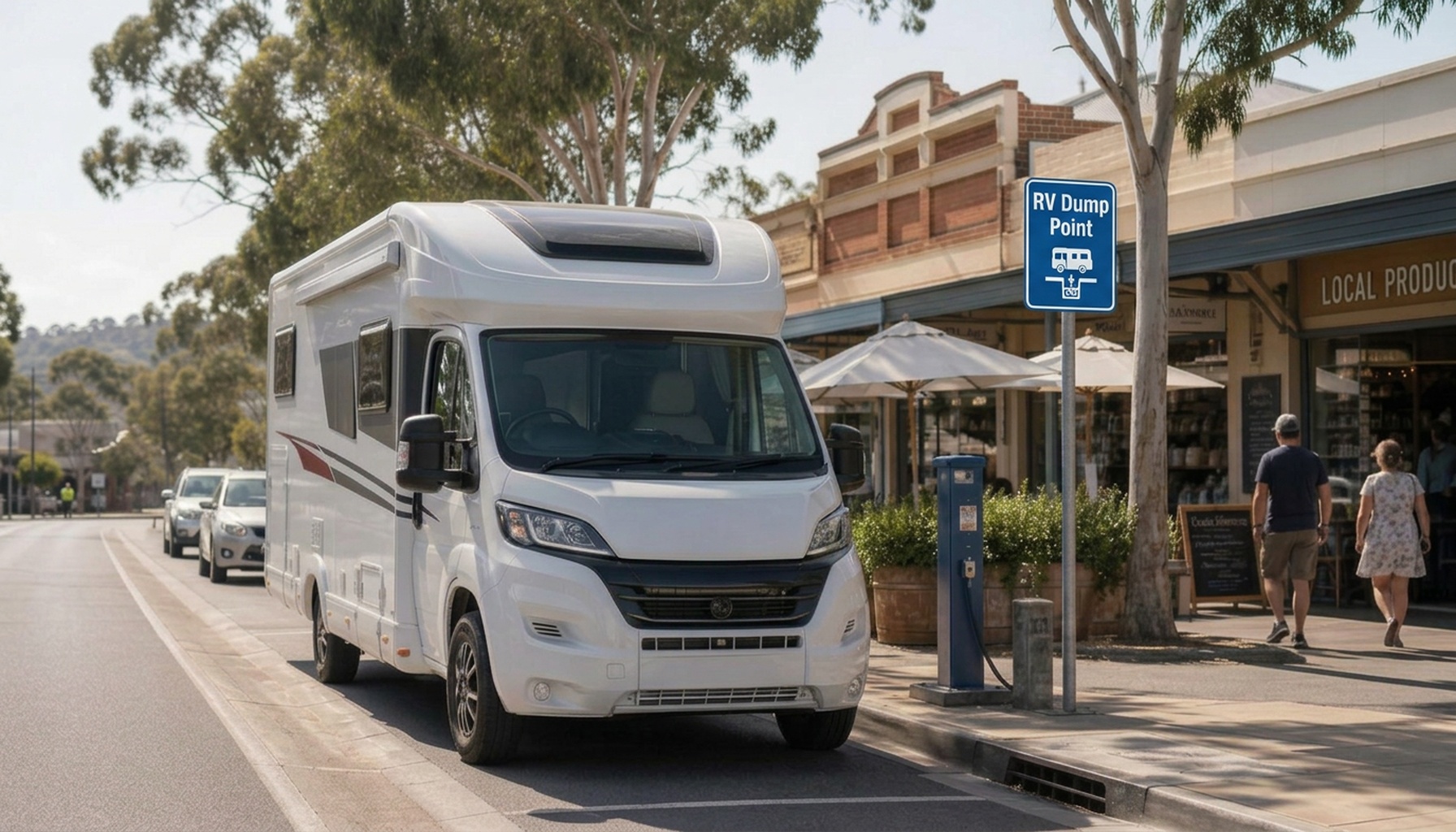
The highest performing RV friendly towns rarely install a dump point in isolation. Instead, they create a visitor services hub that includes potable water, public toilets, waste bins, easy vehicle access, large RV parking, visitor information, walking access to local businesses, and seating and shade.
The objective is to encourage visitors to remain in town rather than simply passing through. Infrastructure should support economic activity, not just operational convenience.
Location Matters
The placement of a dump point is just as important as its construction. Facilities located within walking distance of the town centre consistently deliver stronger economic outcomes than those placed on industrial fringes or highway bypasses.
Successful locations allow travellers to park once, complete essential servicing, walk into town, visit cafés, wineries and shops, and stay overnight. Every additional minute spent in the town centre increases the opportunity for local businesses.
Learning from Successful Regional Communities
Several regional communities across Australia demonstrate that practical visitor infrastructure encourages longer stays and stronger local economies.
Langhorne Creek combines accessible RV facilities with walkable cellar doors, hospitality venues and a welcoming community atmosphere. William Creek proves that even the smallest communities can become iconic overnight destinations when essential infrastructure supports extraordinary visitor experiences. Daly Waters shows that memorable experiences, supported by practical facilities, generate powerful word of mouth marketing that attracts travellers year after year.
Measuring Success
Councils should evaluate RV infrastructure using meaningful economic indicators rather than simply counting facility usage. Measures could include average length of stay, visitor spending, caravan park occupancy, retail sales trends, visitor satisfaction, online reviews, repeat visitation and local business confidence.
Final Thought
A dump point does not generate economic value because people empty their tanks. It generates value because it gives travellers a reason to stop.
The most successful regional councils no longer view RV infrastructure as an expense. They recognise it as an investment in the visitor economy and a practical way to strengthen local businesses, support employment and build more resilient regional communities.