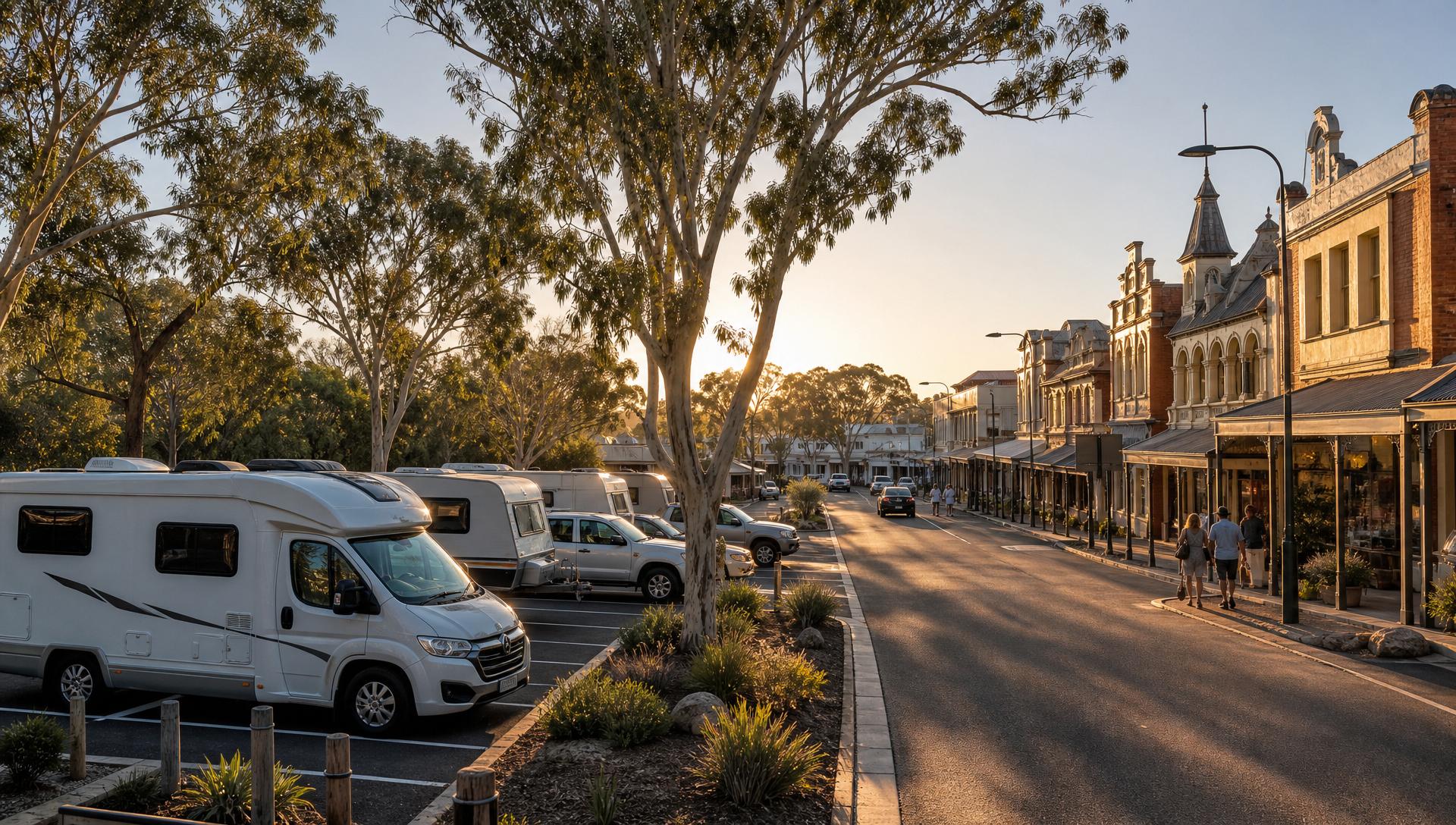
Executive summary
Across Australia, regional councils are increasingly recognising the value of the visitor economy. Many have invested in visitor centres, main-street beautification, events and destination marketing. Yet one of the simplest and most cost-effective opportunities often receives the least strategic attention: the free 24 hour RV stay precinct.
Done well, a 24 hour stay precinct is not simply somewhere for travellers to spend the night. It is an economic development asset that encourages visitors to stop, explore, spend locally and often extend their stay.
Done poorly, it becomes little more than a parking area — limited economic value, and concerns from residents and local accommodation providers. The difference lies in planning.
The rise of the self-drive visitor
Australia's caravan and motorhome sector has grown into one of the country's most significant domestic tourism markets. Travellers are increasingly seeking authentic regional experiences, flexible itineraries, smaller communities, local food and wine, nature-based experiences and walkable town centres.
Unlike traditional holidaymakers, they often decide where to stop on the day.
A welcoming, well-designed overnight precinct can be the deciding factor between stopping in your town or driving to the next one. For regional councils, this flexibility represents a major opportunity.
Think beyond parking
One of the most common planning mistakes is viewing a 24 hour stay precinct as a parking project. It is not. It is a visitor experience project.
Visitors do not remember the dimensions of a parking bay. They remember the bakery with exceptional coffee, the welcoming public spaces, the winery recommended by a local, the walking trail beside the river and the friendly conversations with residents.
The role of the precinct is to connect visitors with these experiences.
Planning around the visitor journey
Successful precincts are designed around how visitors actually behave. Every stage of the journey presents an opportunity for local economic activity.
Arrival
Easy access from the highway with clear directional signage that builds visitor confidence before they reach town.
Parking
Large, level drive-through bays suitable for caravans and motorhomes without difficult manoeuvring.
Orientation
Maps, visitor information, walking routes and personal recommendations for local businesses.
Exploration & stay
Visitors walk into town, eat, browse, meet local owners — and often decide to stay another night.
Location is everything
A beautifully designed precinct on the edge of an industrial estate will rarely deliver the same economic outcomes as a modest facility within walking distance of the town centre. The ideal location should allow visitors to reach cafés, bakeries, supermarkets, hotels, visitor centres, museums, wineries, parks and walking trails — without moving their vehicle.
Walkability is one of the strongest predictors of visitor spending.
Essential amenities
Many councils assume expensive infrastructure is required. The reality is different — travellers consistently value well-maintained essentials over luxury facilities.
- —Potable drinking water
- —Public toilets
- —Nearby dump point
- —Waste bins
- —Picnic tables and seating
- —Shade and lighting
- —Visitor information
- —Accessible pathways
- —Dog-friendly areas where appropriate
Designing for large vehicles
Caravans and motorhomes have different needs from passenger vehicles. Planning should consider drive-through parking bays, wide turning circles, low-gradient access, adequate overhead clearance, safe pedestrian movement and clear wayfinding. Small design decisions significantly improve visitor confidence.
Governance matters
Good planning must be supported by good governance. A successful precinct should operate under clear, simple, visitor-friendly policies covering maximum length of stay, vehicle eligibility, waste management, noise expectations, pet management, maintenance schedules and compliance.
Addressing community concerns
Free overnight stays can generate concerns about rubbish, noise, anti-social behaviour or competition with caravan parks. Experience across Australia suggests these are best addressed through appropriate design, good maintenance, clear signage, regular monitoring and strong community engagement. Most self-contained RV travellers are highly respectful of local communities and appreciate well-managed facilities.
Working with local businesses
The purpose of the precinct is to stimulate local spending. Councils should actively involve businesses through visitor discount programs, walking maps, promotion of local experiences, extended café trading during peak travel, weekend events and highlighting regional produce. A visitor who parks once and spends the afternoon exploring generates value across multiple businesses.
Learning from regional Australia
Langhorne Creek, SA
Frank Potts Reserve shows how modest infrastructure combined with exceptional local experiences can create a highly regarded RV destination within walking distance of wineries and hospitality.
William Creek, SA
A tiny resident population, but practical infrastructure supports unforgettable experiences — scenic flights over Lake Eyre and the Oodnadatta Track.
Daly Waters, NT
Authentic hospitality, memorable experiences and visitor-friendly infrastructure have made a remote settlement one of Australia's best-known RV destinations.
Warrnambool, VIC
A larger regional centre that integrates visitor infrastructure with walkable retail, coastal attractions and year-round tourism experiences.
Measuring success
Councils should move beyond simply counting overnight stays. Better performance indicators include average visitor length of stay, visitor expenditure, retail turnover, hospitality sales, caravan park occupancy, visitor satisfaction, online reviews and repeat visitation.
Five planning principles
- 01
Plan for economic outcomes, not parking capacity.
Every planning decision should encourage visitors to engage with local businesses.
- 02
Prioritise walkability.
Visitors who can comfortably walk into town spend more, stay longer and return.
- 03
Keep infrastructure simple — but maintain it exceptionally well.
Cleanliness and reliability create the positive first impressions that drive online reviews.
- 04
Integrate the precinct into the visitor experience.
Maps, local stories, public art and visitor information strengthen destination appeal.
- 05
Design with flexibility.
Accommodate future growth in caravan sizes, changing travel patterns and emerging expectations.
Looking ahead
Australia's caravan and RV market will continue to expand as flexible travel, remote work and longer life expectancy reshape domestic tourism. Communities that invest thoughtfully today will position themselves to benefit from increased visitor spending for decades.
The opportunity is not simply to provide another place to park. It is to create destinations where visitors choose to stop, stay, spend and return.
Conclusion
A free 24 hour stay precinct should never be viewed as a cost. It is an investment in the visitor economy. When planned strategically, it supports local businesses, encourages longer stays, improves road safety, strengthens destination appeal and contributes to more resilient regional economies.
The most successful regional communities understand that the precinct itself is not the destination. It is the gateway.