Executive summary
Almost every regional council in Australia recognises the opportunity in RV tourism. Fewer have successfully translated that opportunity into a funded, governed initiative that survives successive councils, budget rounds and changes in executive leadership.
The barrier is rarely the idea. The barrier is the framing. RV tourism is too often presented as an infrastructure request — a dump point, a sign, a parking bay — when it should be presented as a regional economic development decision.
The most successful councils don’t pitch RV tourism. They pitch regional economic strategy that happens to include RV tourism.
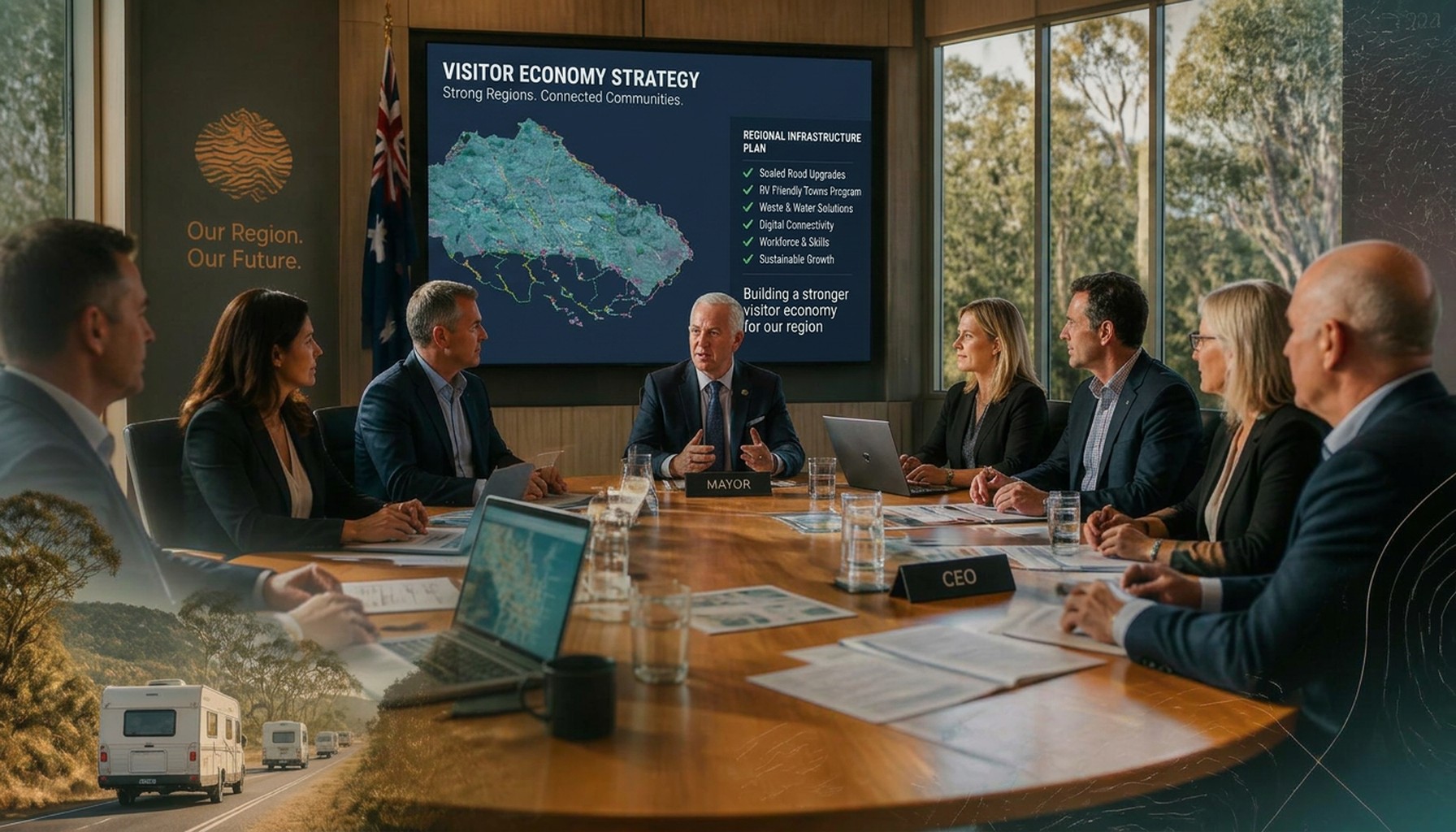
Know who is in the room
A business case lives or dies on whether it speaks to the audience around the table. Each decision-maker is reading the paper through a different lens.
The Mayor
Wants community outcomes, visible wins for ratepayers and a story that resonates at the next election.
The CEO / General Manager
Wants strategic alignment, deliverability, low political risk and measurable performance against the community strategic plan.
The CFO / Treasurer
Wants return on investment, payback period, recurring revenue impact and a disciplined view of whole-of-life costs.
Elected councillors
Want evidence, equity across the LGA, and confidence the proposal will not become a political liability.
A five-step framing framework
These five moves consistently separate proposals that get funded from those that get noted and shelved.
- 01
Position it as economic development, not infrastructure.
RV tourism is a visitor economy lever. Frame the conversation around expenditure, jobs and main-street resilience — not dump points and signage.
- 02
Anchor it in the Community Strategic Plan.
Every initiative should map to existing strategic outcomes: economic prosperity, vibrant places, regional connectivity, sustainability.
- 03
Quantify the opportunity in dollars, not vehicles.
Councillors respond to local spend, length of stay, employment and rate base impact — not visitor counts in isolation.
- 04
Show the governance model, not just the project.
Demonstrate who owns delivery, how risks are managed, how operators are engaged and how outcomes will be measured.
- 05
Make the recommendation decision-ready.
Provide a clear options analysis, a preferred option, a costed plan and an executive-ready resolution.
Councillors approve strategies. Executives deliver business cases. Treasurers fund returns. Make sure your paper does all three.
What a credible business case contains
Every council expects a recognisable structure. Use the language and sequencing already familiar to executive teams.
- —Strategic context and alignment to the Community Strategic Plan
- —Problem definition and the cost of inaction
- —Options analysis with a preferred option
- —Capital and operating cost profile
- —Economic impact and return on investment
- —Risk assessment and mitigation
- —Stakeholder and community engagement plan
- —Governance, delivery and measurement framework
The economic case, in numbers
A well-constructed RV tourism business case is one of the highest return investments a regional council can make. The figures below are indicative of a typical regional LGA.
Typical capital outlay
$40k
Dump point, signage and minor amenity upgrades to become a credible overnight destination.
Annual visitor spend
$1.2M+
Indicative additional expenditure flowing to local businesses when stays convert from bypass to overnight.
Payback period
<24 months
Most well-designed precincts deliver a net positive return within two budget cycles.
Rate base impact
Recurring
Stronger main-street trading underwrites commercial property values and local employment.
A decision-making flow for council executives
A simple, repeatable sequence helps the proposal move from briefing to resolution without losing momentum at any stage.
- 01
Strategic case
Why this matters to the LGA and how it aligns with the Community Strategic Plan.
- 02
Economic case
Quantified benefits, costs, ROI and sensitivity analysis.
- 03
Delivery case
Procurement, partnerships, timeline and resourcing.
- 04
Governance case
Risk, oversight, KPIs and reporting cadence to council.
- 05
Council resolution
A clear, decision-ready recommendation the executive can stand behind.
A cross-departmental governance model
RV tourism initiatives stall when they sit with a single officer. A clear governance model assigns ownership across the organisation and signals to the executive that the proposal is properly resourced.
Economic Development
Owns business case and KPIs
Tourism / Visitor Services
Owns visitor experience and marketing
Planning & Development
Owns approvals and land use
Engineering / Assets
Owns delivery and whole-of-life cost
Finance
Owns budget, ROI model and reporting
Office of the CEO
Owns governance and council reporting
Checklist: presenting to a Mayor, CEO and Finance Director
- One-page strategic summary on the cover
- Alignment to the Community Strategic Plan stated explicitly
- ROI, payback and recurring revenue impact quantified
- Risk register with mitigations
- Clear preferred option and decision-ready resolution
- Endorsements from at least two operating departments
- Plain English — no jargon, no acronyms unexplained
- Visible photo, map or render to anchor the conversation
Conclusion
RV tourism deserves a place on the council agenda. But it earns that place by being framed as what it actually is: a long-term economic development strategy with measurable returns, manageable risks and a clear governance model.
When the paper speaks the language of the executive, references the Community Strategic Plan, quantifies the dollars and offers a decision-ready resolution, RV tourism stops being a once-a-budget-cycle conversation. It becomes part of how the region grows.
Strategy is what gets funded. Infrastructure is what gets delivered. Lead with strategy.